

23 March 2017.
László Lőrinc
They say that following the political bluster campaigns of 2016 in the UK, the US and Hungary, the post-fact, post-reality or post-truth era of politics has begun. Apparently the same is happening to history.
“Sixty years after the revolution, those with personal memories are slowly leaving us, and the time of legends is coming. And legends are beautiful: sublime, exciting, human, self-sacrificing (sic!). My goal is to make 1956 the most beautiful Hungarian legend”, Mária Schmidt, the government commissioner for the 1956 Commemoration Committee, told Tokaji Hírek in August.
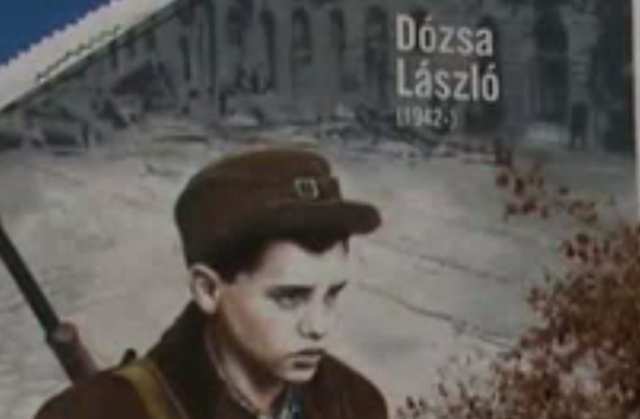
Why, then, was anyone surprised by anything that happened to the 1956 story afterwards? That, for example, in the picture of Pál Pruck covering entire firewalls, Schmidt & Co. rewrote the protagonist’s name to László Dózsa’s (the heroic freedom fighter, who spread spectacular legends of his multiple executions and simultaneous satisfaction of seven women). Schmidt, seeing that Pruck had already left us, went into legend mode. What she didn’t take into account was that witnesses sometimes tell their stories before they die. And Pruck’s daughter, Erika Csőkéné Pruck, insisted that the 14-year-old boy in the picture was indeed her father, who “was not a freedom fighter, but just a kid who was there”. This mundane little historical fact weakened the sublime legend, but only temporarily, because time, as far as the existence of the children of witnesses is concerned, works for the legend… What is that poem from ’56? “He decides who you were, even your name serves him”.
And who can be surprised that, apart starting from the armed schoolchildren, everyone else up to Imre Nagy was left out of the story, even – as Géza Jeszenszky, the historian and former foreign minister of the Antall government, pointed out – the enemy, the Soviets themselves, and the Americans took their place? It is so sublime, so beautiful, so human – and so Putin-like.
And who can be surprised by the blatant lie of Schmidt’s museum concerning Népszabadság?
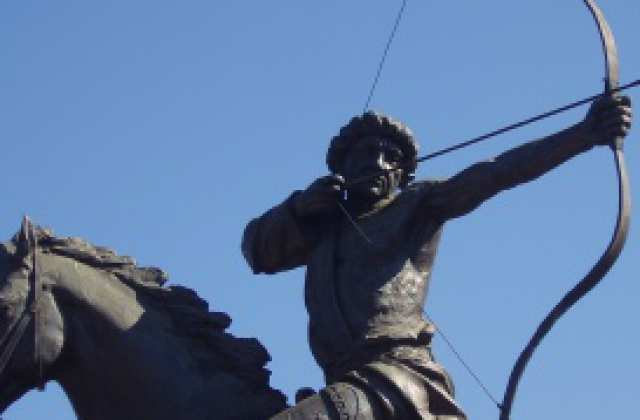
Or by the fact that András Bencsik – being a political columnist of Népszabadság when its warningly raised index finger was a beacon of communism – sees nothing wrong with the fact that the now-demolished newspaper, which had been independent and all-round critical for a quarter of a century, is compared to the Nazi Völkischer Beobachter by its executioners. Moreover, he questions the human decency of anyone who reminds him about this minor biographical contradiction. Bencsik, who founded the Szkítia (Scythia) bookshop network that spreads the wildest, most contradictory Hungarian origin legends, replaces the legend of Soviet-Hungarian friendship with that of Scythian-Hungarian identity. Obviously, he believes in the wonderful and sublime history beyond reality, and that he himself can be one of its protagonists.
After this, it should come as no surprise if at the Népszabadság exhibition opening in the House of Terror, the faces of the paper’s discredited editors would be photoshopped to wear ÁVH uniforms, butcher’s cleavers in their hands, and an interrogation room as a background, through the window of which a section of the Keleti railway station bombed to ruins and full of migrants would be visible. The whole picture would be complemented by a Népszabadság title over it, smeared with red paint, and opposite it, behind a barricade built of grey Styrofoam cubes, would be put a wax figure of András Bencsik, dressed as a Resistance fighter, with a scarf in national tricolour waved by a wind machine. An image of George Soros would be mounted behind the murderous editors, lit form below, with his incisors slightly enlarged, and on his shoulders would rest the long clawed hands of US President Eisenhower, grinning with missing teeth at the defeat of the revolution.
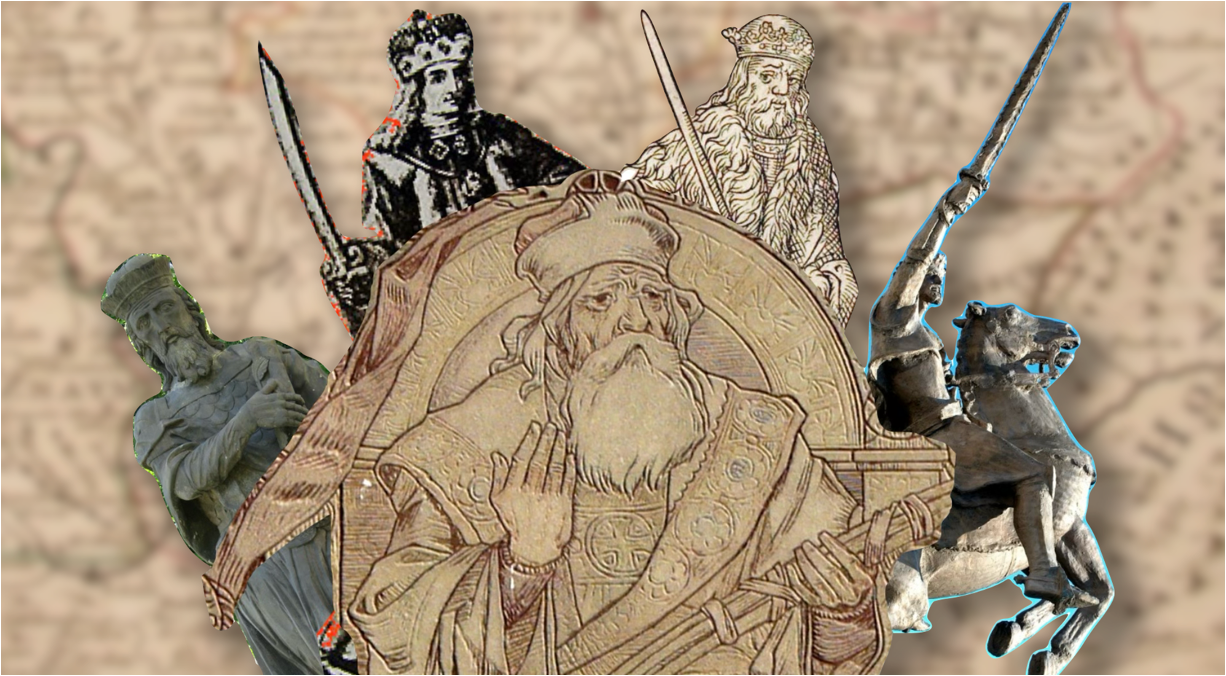
Nothing will surprise us any more, given the principles proclaimed. Which principles, by the way, are not so new. The historian László Tőkéczki announced the advent of post-reality history years ago, in the epilogue to the representative edition of the Fundamental Law of Hungary. According to him, “historical memory … is ancient, full of mythical elements, and has little in common with the findings of modern historians … But in its main features, this memory has preserved the truth. … From the deep past, it emphasises the solemn, the outstanding and, accordingly, the magnificent and the beautiful; posterity moulds these events into its own image, often without any contemporary objectivity. … Certainly, this ‘historical picture-book’ was not intended to be a hyper-objectively scientific work, as perfect factuality and historical professionalism are not among its aims. In fact, its admitted goal is to revive and strengthen the community and national identity that is flourishing again in the 21st century among the new generations of our people. One might call this outmoded, but then our question would be: why do postmodern multinationals seek to build a corporate identity for their employees?”
And that’s the point. The state’s promotion of a certain type of national identity even a century ago, in its heyday, was in a sense a business issue. Back then a four-year world war that claimed millions of victims was successfully sold to the addicts of the various European patriotic brands, and historians, history teachers and museologists were equally in on the marketing campaign: each nation knew only the solemn, the sublime, the grandiose from its very own history for exclusive domestic use, and only the embellished ignominies from its neighbour’s. In the following world wars, an improved version of national identity contributed to the incursions launched by the Germans, Italians, Hungarians, Romanians or Soviets. For a long time, our continent seemed to have learnt a lot from all this, and became more and more reflective, albeit hesitantly, on the history of its hostile neighbours and itself. But liberated from communism, the inter-Europeans seemed to have gone back to the old ways, and started to use their glorious pasts as weapons against each other again. For example, one of the sparks that ignited the Balkan Wars was the Serbian head of state’s great history-interpreting speech on the 600th anniversary of the Battle of Kosovo.
The attitude of abolishing taboos concerning nationalist bias and sweeping away correctness towards the history of other peoples was put on a pedestal in Hungary years before this year’s campaigns by the creed of the Fundamental Law and the commemorative edition itself. The very first page of the book contains a picture of a Scythian golden deer, an object that can only be considered Hungarian by the dreamy Sumerian-Parthian-Scythian-Etruscan-Hun books distributed by András Bencsik (this was also mentioned by former head of state László Sólyom when describing the commemorative edition, pointing out that the picture at the end of the publication sells the Greek Ganymede as the Hungarian Emese.)
The falsification of history happened before, of course, but it was not done to admit to it. The historians of the new, beyond-reality history are no longer chaste. They are just as bold in declaring that not reality is what counts, as Lenin proclaimed, that there is no morality in the traditional sense: anything is moral that is useful for the proletariat. (Of course, in fact, for the state acting on behalf of the proletariat.) In the opinion of the new historians, anything is history that is useful for the nation. (Of course, in fact, for the political state power acting in the name of the nation.) Thus the “petty bourgeois moralizing” here, the “hyper-objectively scientific” history there, the “sort of perfect factuality and professionalism”, become the object of derision.
It’s true enough that celebrating the legendary past fosters a sense of community belonging in Indigenous Australian ceremonies as much as in modern national celebrations, and it is also appropriate that the celebration of the past is a way of celebrating the past. It also has its place in storybooks, primary school readers and adventure films. However, normally the people who put together these works for festive audiences and children are shamans, writers, film-makers, event organisers rather than historians. The continued involvement of the latter, and indeed of entire history institutes, in all this is nothing less than a self-inflicted dismantling of their profession, very much the same way as if theatre critics who had forgotten about their true calling would run the ticket sales. What is useful for the nation is to learn about its real past, not the lofty grandeur that intrudes into everyday history lessons, museums and textbooks. That is particularly harmful.
The good news is that these pomp-legends will, as the unintentional direct hit of Mária Schmidt goes, over time ‘self-sacrifice’ themselves: as they climb to the heights of science, they will lose their balance, become ridiculous and fall off due to all the splendid, protruding and bombastic ornamentation and implausibility being difficult to balance. At least that has been the practice so far.
The bad news is that you usually had to lose a war to get this effect.
Common past: knowledge to dispel historical misconceptions – supporting the work of Slovak and Hungarian history teachers through print and online publications, professional conferences. A project of the Association of History Teachers and the Hungarian-language newspaper of the Denník N news portal. (2023-2-HU01-KA210-SCH-000169882)
Funded by the European Union. The information and statements contained herein are those of the author(s) and do not necessarily reflect the official views of the European Union or the Tempus Public Foundation. Neither the European Union nor the funding authority can be held responsible for them.