

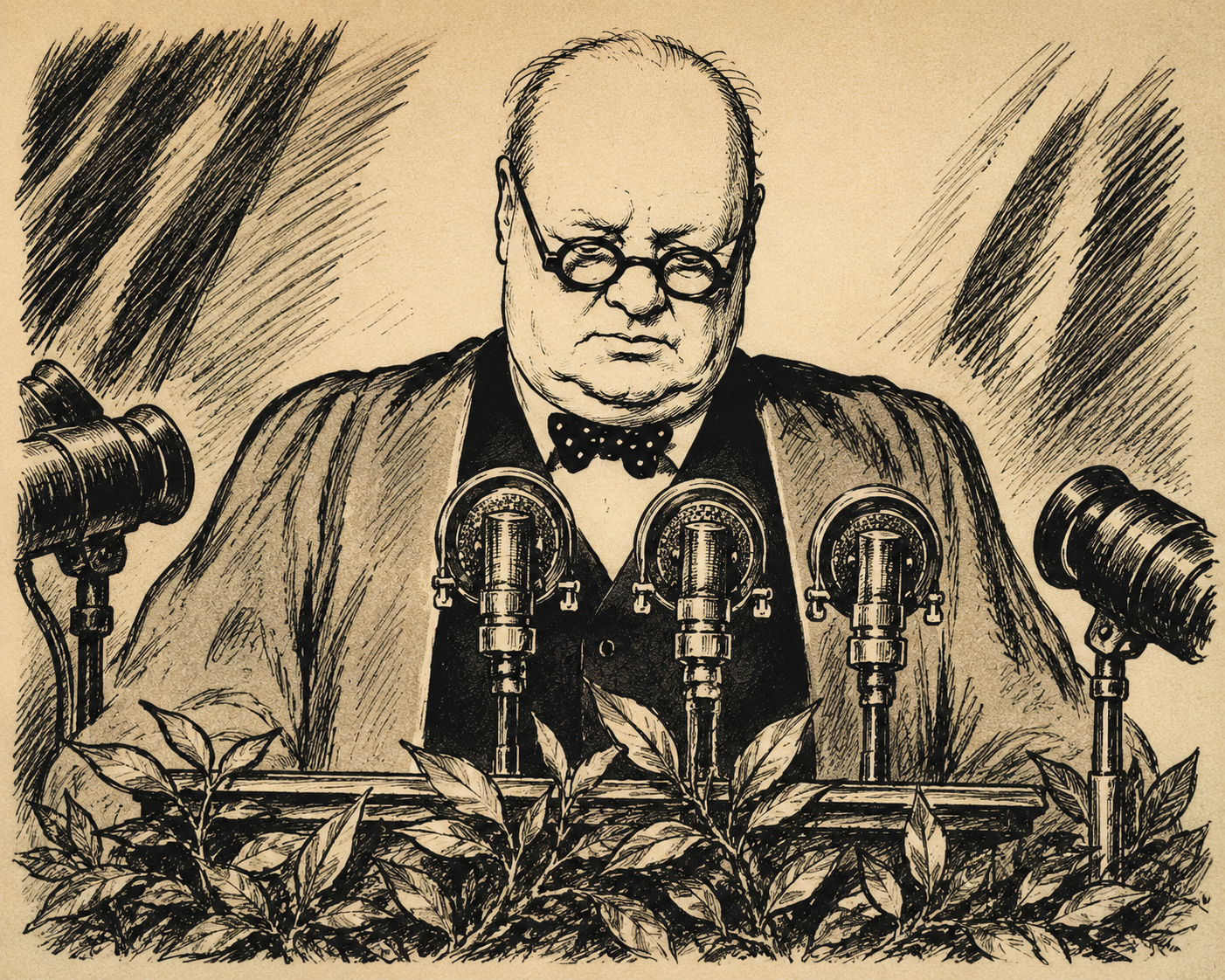
Claim: On 5 March 1946, in his famous speech at Fulton, Missouri, Winston Churchill declared:
“From Stettin in the Baltic to Trieste in the Adriatic, an iron curtain has descended across the Continent.”
Most history textbooks regard this moment as the beginning of the term’s international prominence.
Short explanation: Although it is widely believed that Churchill was the first to use the expression “iron curtain” in his Fulton speech, the available evidence suggests that Otto Grotewohl had already employed the phrase about a month earlier. Churchill may well have learned of it through British diplomatic reports. Nevertheless, it was unquestionably the Fulton speech that made the term famous worldwide.
Detailed explanation: On 4 February 1946, Otto Grotewohl, leader of the Social Democratic Party (SPD) in Berlin and the Soviet occupation zone of Germany, held a confidential conversation with Sir Christopher Steel, head of the Political Division of the British Military Government. During the meeting, Grotewohl remarked:
“The iron curtain has now descended.”
Grotewohl was not referring to the broader division between East and West. Rather, he was describing the desperate situation of his own party. At the time, the Soviet occupation authorities were exerting enormous pressure on the Social Democrats to merge with the Communist Party. By using this expression, Grotewohl was effectively telling his British counterpart that the SPD had lost its room for manoeuvre and would ultimately be forced to accept unification with the Communists. Only a few months later, this prediction came true with the creation of the Socialist Unity Party of Germany (SED), which subsequently became the ruling party of East Germany.
When Churchill spoke publicly about the “iron curtain” in Fulton a month later, he likewise referred to developments in Germany. He accused the Soviet Union of seeking to establish a communist Germany in the territory occupied by the Red Army, arguing that the forced merger of the Communists and the Social Democrats was clear evidence of this policy.
This raises an obvious question: where did Churchill encounter the phrase? Although there is no direct proof, some historians consider it likely that he learned of Grotewohl’s February statement through British diplomatic channels. Sir Christopher Steel’s report was forwarded to London, making it entirely possible that Churchill became familiar with the expression before incorporating it into the speech that would make it world-famous.
This does not, however, mean that Churchill “invented” the term. The expression iron curtain had existed since the nineteenth century. Originally, it referred to the fireproof metal curtain installed in theatres to prevent the spread of fire. Later, several politicians and journalists adopted the term as a political metaphor. Churchill’s achievement was therefore not that he used the phrase first, but that he transformed it into the defining political metaphor of the Cold War.
The cover image is intentionally playful: created with the assistance of ChatGPT, it simultaneously evokes the iconic visual language of the Cold War while subtly subverting the familiar imagery and clichés of 1950s propaganda with a touch of irony.